ART OF DIASPORA
The artist: Cemo
The title: Invasion
Medium: acrylic on canvas
Dimensions: 152 x 122 cm
The date: 18.07.2020. London
Price: £10,000
Invasion emerges from the unprecedented global pandemic caused by the coronavirus—an invisible and unfamiliar adversary that entered human existence without warning, disrupting the structures upon which contemporary life had come to depend.
Unlike a conventional catastrophe, its most profound impact cannot be measured solely through the number of lives lost. The virus infiltrated something more expansive: the collective consciousness of humanity. It generated an atmosphere of uncertainty in which economic instability, financial anxiety, and the fear of an unknown future became almost as pervasive as the disease itself.
What fascinated me was not only the virus as a biological phenomenon, but the psychological transformation it provoked. Faced with the possibility of scarcity, people began to behave as though the familiar order of civilisation were collapsing. Supermarkets became arenas of anxiety; queues lengthened; essential goods were accumulated with an almost instinctive urgency. Sanitiser, food, and toilet rolls became unexpected symbols of survival. The impulse to stockpile revealed something deeply primal within us—the fear that, if we do not secure our own existence, we may be left behind.
The pandemic also transformed our relationship with one another. Lockdown and self-isolation imposed an unprecedented distance upon human beings, severing the ordinary gestures through which intimacy is expressed: touch, proximity, physical presence. A species defined by its social nature was suddenly compelled to experience closeness as a potential threat. The body itself became a paradox—simultaneously the instrument through which we experience human connection and the possible vehicle of contagion.
This atmosphere of uncertainty recalled for me the psychological landscape of war. Yet this was a war without visible battlefields, without a clearly identifiable enemy, and without a conventional front line. The conflict had entered the most intimate spaces of everyday life. Humanity was fighting not only against a virus, but against fear, isolation, scarcity, economic insecurity, and the instinct for self-preservation.
As I contemplated how to translate this extraordinary moment onto the canvas, I realised that the pandemic contained too many layers—social, psychological, economic, biological, and existential—to be contained within a single image. Invasion therefore became the beginning of a larger artistic investigation: a series through which I could examine the many faces of this collective experience.
The work ultimately becomes a meditation on survival. It asks what remains of human behaviour when certainty disappears, when the invisible becomes more powerful than the visible, and when the instinct to protect oneself begins to compete with our responsibility towards one another.
In this sense, Invasion is not merely a representation of a pandemic. It is a reflection upon humanity confronted by its own vulnerability—a moment in which civilisation, stripped of its apparent security, is forced to confront one of its most ancient fears: the struggle to survive.

The artist: Cemo
The title: Harvest Time
Medium: acrylic on canvas
Dimensions: 152 x 122 cm
The date: 10. 05. 2019, Middlesex University,London
Price: £2,000,000
In today’s world, perhaps the cheapest and most worthless thing has become human life.
We choose war instead of peace; dictatorship instead of democracy; death instead of life. We choose greed, selfishness, and meanness instead of sharing, compassion, and solidarity.
Intolerance has become one of our dominant attitudes and practices.
Instead of moving forward, we are unfortunately witnessing a backward-looking mentality, both theoretically and practically—one that attempts to bring back the darkness of oppressive regimes and the mentality of the medieval past.
In this metaphorical landscape, the field is made of human beings. They are surrendered, trapped, and besieged by death. Death appears in the form of an unknown creature—an executioner—who moves through the field with a scythe, cutting down and destroying human lives.
The field is humanity.
The farmer is the killer.
The harvest is human life.
The landscape is dark, stormy, and oppressive. There is no sound of celebration, growth, or renewal. Instead, there is only the unbearable silence of death.
Traditionally, harvest is a time of abundance, fertility, and the gathering of the fruits of life. Here, however, the meaning of harvest is turned upside down. The field does not produce crops; it produces victims. The farmer does not cultivate life; he cultivates death.
Harvest Time is therefore a metaphor for our present condition: a world in which human beings have become the harvest, while violence, intolerance, greed, and the desire for power have become the forces that reap them.
It is a landscape where the value of human life has been forgotten—and where death has become the final harvest.

The artist: Cemo
The title: All Together, Side by Side
Medium: oil on canvas
Dimensions:152x122 cm
The date: 18 December, 2018, Middlesex University, London
Price:£20,000
As a British artist of Kurdish origin, I have been interested in how my cultural heritage can become part of my artistic identity within British society, while also allowing me to express my political and human concerns. I wanted to create a painting that could exist between cultures—a work rooted in my own history and experience, yet connected to a shared British and European historical memory.
The starting point of this painting is a simple opposition:
Life against death.
Peace against war.
Rebirth against destruction.
I wanted to imagine a world in which soldiers are no longer the final image of war, and where, instead of producing more deaths, the earth gives birth to new life.
Since living in Britain, I have come to understand the significance of Remembrance Day and the important place it holds within British society and historical consciousness, as well as within the wider Commonwealth and other countries that commemorate the losses of war. The red poppy has become one of the most recognisable symbols of remembrance, particularly in connection with the First World War. For me, however, the poppy carries a double meaning: it remembers those who died, but it can also represent hope—the possibility that remembrance may lead us away from repeating the same tragedies.
This idea became the foundation of the painting.
At the forefront, I imagined an immense field of red poppies. The field refers to the landscapes of the First World War, where countless soldiers died. They lie metaphorically all together, side by side, regardless of nationality, ethnicity, religion, or political identity.
But I wanted to transform this familiar image of remembrance.
Instead of dead soldiers, I placed newborn babies within the hearts of the poppies. They are not victims; they are symbols of rebirth, innocence, possibility, and hope. They grow together, side by side, in peace. The same field that once became a place of death is transformed into a place of new life.
Above this field is the Sun, the fundamental source of light, energy, and life within our planetary system. Its presence represents life itself—the force that makes growth and renewal possible. Its light reaches everything without discrimination.
Around the Sun, the planets move in their own orbits. Each planet maintains its own identity, colour, character, and tone, yet they coexist within the same system. None needs to destroy another in order to exist.
For me, this becomes a metaphor for human society.
We can have different identities, histories, cultures, languages, beliefs, and political perspectives, while still existing beside one another in peace. Difference does not have to become division, and identity does not have to become a reason for conflict.
This is also where my Kurdish background becomes part of the work. Coming from a people whose modern history has been deeply marked by conflict, displacement, political struggle, and the consequences of war, I cannot approach the subject of peace as something purely abstract. At the same time, as a British artist, I am engaging with the historical language of remembrance that I have encountered and experienced in Britain.
The painting therefore brings these different experiences together.
The poppy field represents remembrance and the human cost of war.
The babies represent life, renewal, and the possibility of a different future.
The Sun represents the universal force of life and hope.
The planets represent different peoples and identities, each retaining its individuality while sharing the same space.
And the phrase “All Together, Side by Side” becomes both the title and the central proposition of the work.
We do not need to become identical in order to live together.
We can remain different and still be side by side.
The painting is ultimately an anti-war statement, but it is also a statement about coexistence. I want to acknowledge the dead without glorifying death; to remember war without accepting it; and to use remembrance not as an invitation to repeat history, but as a responsibility to create something better.
The battlefield becomes a field of life.
The poppy becomes not only a symbol of remembrance, but a vessel of rebirth.
The soldiers become babies.
Death gives way to life.
And humanity, all together, side by side, is given another chance.

The artist: Cemo
The title: That was me
Medium: acrylic on canvas
Dimensions: 152x122 cm
The date: 06.11.2019. Middlesex University, London
Price:£2,000,000
My artworks are generally political and rooted in true stories. Even when I work through imagination, my images emerge from my personal background, memories, and historical events that took place in Kurdistan and Mesopotamia. I bring these memories into the present and reconstruct them through a semi-surrealistic visual language.
That Was Me is one of the most personal works in my artistic practice.
The painting refers to a journey I made to Turkey during a period of fascist military rule and political repression following the 1980 military coup. It recalls scenes connected to torture, interrogation, imprisonment, and encounters with police and military authorities. These were not distant historical events for me. They were experiences that happened to my own body and became part of my memory.
That period did not simply take away years of my youth. It left physical and psychological wounds that continued long after the events themselves had ended. The body remembers what history attempts to erase.
For this reason, That Was Me is both a personal memory and a historical testimony.
I do not attempt to reproduce these experiences literally. Instead, I transform them through imagination and semi-surrealism. Reality becomes distorted because traumatic memory itself is often fragmented, uncertain, repetitive and haunting. Images from the past return in unexpected forms, connecting the personal experience of one individual with the wider political reality of an entire period.
My decision to respond through art came from a desire to resist silence.
I wanted to fight back through painting—to transform pain, anger and memory into a visual language. What I once experienced as violence against my body and spirit became a reason to create. My response is not physical revenge; it is the persistence of memory. The painting becomes my resistance.
In this sense, my paintings are witnesses.
They bear witness to a dark period of history, to experiences that were hidden, suppressed, or deliberately forgotten. They attempt to become a mirror reflecting the secret and uncomfortable parts of reality—the parts that official histories may leave in darkness.
The title That Was Me is deliberately direct.
It is not simply a statement about the person depicted in the painting. It is an act of identification. It says: I was there. I experienced this. This is part of my history.
At the same time, the words can extend beyond the individual. The person in the painting can become a symbol of many others who experienced imprisonment, torture, political persecution, displacement, and violence.
Therefore, That Was Me moves between the personal and the collective.
It is my memory, but it is also a fragment of a larger history.
It is a record of suffering, but also a declaration of survival.
And it is an act of resistance against the disappearance of memory.
My paintings are therefore not simply illustrations of the past. They are attempts to bring the past into the present—to make hidden histories visible again and to confront the viewer with realities that are often easier to ignore.
That Was Me is ultimately a statement of survival:
You may have wounded my body.
You may have taken my youth.
You may have tried to silence me.
But you could not take away my memory.
I remember.
I paint.
I resist.

The artist: Cemo
The title: Everything is different, everything is the same
Medium: oil on canvas
Dimensions: 152 x 122 cm
The date: November,2019. Middlesex University,London
Price:£2,000,000
The painting is therefore not intended to suggest that the two conflicts are historically identical. They are not. Rather, I am interested in the repetition of certain patterns within human history—the way violence, political oppression, resistance, international intervention and human suffering return in different forms.
My own Kurdish background makes this subject particularly personal. The history of Kurdistan has repeatedly been shaped by conflict, displacement, political repression and struggles over identity and self-determination. Consequently, when I look at historical events elsewhere, I do not see them simply as distant stories. I recognise echoes of experiences that are part of my own historical and cultural memory.
I bring these histories into the present through a semi-surrealistic visual language. The painting does not attempt to reconstruct either conflict literally. Instead, I merge fragments of history, memory and imagination to create a new visual reality.
For me, painting is a way of confronting the repetition of history.
The past is not truly past when its patterns continue to appear in the present.
The faces may change.
The uniforms may change.
The weapons may change.
The geography may change.
But the human consequences remain.
The work therefore asks the viewer to consider whether humanity has really learned from its history.
Why do we continue to reproduce violence?
Why do different identities so often become reasons for hatred?
Why do political and military powers repeatedly sacrifice human lives for ideology, territory and power?
And, most importantly, how many times must history repeat itself before we recognise the pattern?
Everything Is Different, Everything Is the Same is my attempt to place two distant historical moments into the same visual and emotional space. It is a reflection on war, resistance, identity, international solidarity and the persistence of human suffering.
It is also a warning.
History does not simply repeat itself.
We repeat it.
And if we continue to do so, the difference between the past and the present becomes only an illusion.

The artist: Cemo
The title: Destabilisation
Medium: acrylic on canvas
Dimensions: 150 x 120 cm
The date: October, 2019. Middlesex University,London
Price:£2,000,000
Almost fifteen years ago, I began searching for a unique visual language through which I could develop my artistic practice. During a period of intense brainstorming, experimentation and even dreams, an idea gradually emerged: to use letters and numbers as representations of human beings and to construct paintings from them.
This became the beginning of a new visual language within my work.
My main intention was to translate into art the movement, revolution and transformation taking place within Kurdish society. I was interested not only in political and social change, but also in the deeper spiritual transformation of the Kurdish people—the changes that take place within a society when its understanding of itself, its identity and its future begins to shift.
In Destabilisation, human beings are replaced by signs.
The letters represent the Kurdish people and democratic forces. They are active, changing and moving, suggesting collective identity, communication, resistance and the possibility of constructing a different future.
Opposing them are the black numbers, which represent forces of destruction: terrorism, criminal gangs, authoritarian and fascist states, and systems of political violence.
By transforming people into letters and numbers, I remove their conventional physical identities. They become signs within a larger political and social structure. The painting therefore operates somewhere between language, mathematics and human existence.
The title Destabilisation refers to the disruption of an established order. It describes a society in a state of tension and transformation, where existing political structures, identities and relationships are being challenged. Destabilisation can be destructive, but it can also create the conditions from which something new may emerge.
This ambiguity is important to the work.
I am not interested in depicting political conflict as a simple confrontation between two fixed sides. Instead, I am interested in movement—the constant struggle, transformation and reorganisation of society.
The letters and numbers become participants in this movement.
They collide, separate, gather, expand and transform. Their arrangement creates a visual representation of a society in motion.
At the same time, this work is part of my continuing investigation into multidimensionality. I am interested in the possibility that an image does not have to exist within a single visual or conceptual dimension. Letters and numbers can simultaneously function as symbols, figures, language, mathematical forms and political characters.
The painting therefore creates a world in which the boundaries between human beings, language, mathematics, politics and visual form become uncertain.
For me, this uncertainty reflects the nature of social change itself.
A society is never completely stable.
Identities change.
Ideas change.
People change.
Political structures change.
And sometimes, from that destabilisation, a new consciousness can emerge.
Destabilisation is therefore not simply a representation of conflict. It is an exploration of transformation—the movement from an established order toward an uncertain future, and the possibility that resistance and change can eventually create a new form of collective existence.

The artist: Cemo
The title: Released Nightmares
Medium: acrylic on canvas
Dimensions: 152 x 122 cm
The date: 05.05.2019. Middlesex University,London
Price:£2,000,000
The complications and chaos of the contemporary world and human relationships are
at the centre of Released Nightmares.
This work explores the impact of nuclear danger, poverty, threats, screams, death, oppression, annihilation and, paradoxically, beauty on the consciousness of an
artist—and how these realities can emerge aesthetically as unrestrained nightmares.
We live in an extraordinary technological age.
Human beings are developing technology at a vertiginous speed. We invent increasingly sophisticated machines and artificial intelligence, develop robots capable of performing
tasks once reserved for humans, explore cloning and genetic technologies, and send increasingly advanced instruments into space. We look towards Mars and other
planets, imagining that one day they might become a second
home—or even a colony—for humanity.
Yet, at the same time, we are confronted by another reality.
Global warming, tsunamis, earthquakes, forest fires, wars, poverty, political oppression
and nuclear threats continue to threaten human existence. Conflicts and contradictions between social classes, states, nations, genders, religions and political ideologies remain deeply embedded in contemporary life.
Many of these crises are not simply natural disasters or unavoidable circumstances.
They are also consequences of human decisions and human actions.
This contradiction is fundamental to the work.
We are capable of reaching into space while failing to establish peace on Earth.
We can create technologies of extraordinary sophistication while continuing to create weapons capable of destroying ourselves.
We search for life on other planets while allowing human life on our own planet to remain threatened.
Released Nightmares emerges from this contradiction.
The nightmares in the painting are not entirely imaginary. They are released from the realities surrounding us. They are fragments of contemporary life transformed through my imagination and brought together within a single visual space.
As an artist, I cannot remain outside these realities. The political, social and environmental conditions of the world inevitably enter my consciousness and become part of my visual language. Fear, beauty, destruction and hope can exist simultaneously within the same image.
The work also continues my investigation into multidimensionality.
During the creation of the painting, I deliberately changed the orientation of the canvas.
I wanted to experience the work from different perspectives—to turn it, reconsider it, discover new forms and allow previously hidden objects and relationships to emerge.
The painting can therefore be viewed in four different orientations: vertically and
horizontally, as both portrait and landscape.
This was not simply a technical experiment. Changing the orientation changes the relationship between the elements and consequently changes the way the viewer
perceives the image.
There is no single fixed point of view.
A different direction can reveal a different reality.
An object that appears one way from one position may become something entirely
different when the painting is turned.
This physical transformation of the artwork reflects the conceptual instability of the
world represented within it.
Reality itself can be viewed from different directions.
What appears beautiful can contain destruction.
What appears progressive can contain danger.
What appears to be a technological achievement can create a new threat.
What appears to be a nightmare may actually be a reflection of reality.
Through Released Nightmares, I transform the anxieties of contemporary existence
into a visual and aesthetic experience. The painting becomes a space where
technology and destruction, beauty and horror, progress and catastrophe, human
creativity and human self-destruction collide.
The nightmares have been released.
They are no longer confined to our dreams.
They are part of the world we have created.

The artist: Cemo
The title: Garden of Daisy
Medium: acrylic on canvas
Dimensions: 152 x 122 cm
The date: 26.03.2018. Middlesex University, London
Price:£2,000,000
The Sun is the origin and fundamental source of life on Earth. Human existence,
nature, fertility and the continuation of life are all dependent upon the energy and light
that the Sun provides.
In Garden of Daisy, I begin with this relationship between the Sun and the natural world. Through its energy, living organisms grow, reproduce and continue their existence.
The cycles of nature are therefore based upon a continuous process of creation, growth, fertility and renewal.
I extend this natural principle into the human world.
Within the continuation of human life and the formation of a family, the woman is an
essential and irreplaceable presence. Through pregnancy, birth and nurturing, the
female body becomes one of the fundamental sources through which life continues. The breast, in particular, carries an important biological and emotional meaning: it provides nourishment to the newborn child and represents the earliest source of energy through
which a human being grows.
In this work, I wanted to create a connection between these two forms of
nourishment—the cosmic energy of the Sun and the maternal nourishment of the woman.
The Sun gives energy to the Earth.
The Earth gives life to nature.
The mother gives nourishment to her child.
These relationships form a continuous chain of life.
I use the daisy as a central metaphor for this connection. The flower becomes an
aesthetic transformation of the female breast, bringing together the forms of nature
and the human body. Rather than separating the woman from nature, I wanted to
reveal their fundamental connection.
The breast is therefore not presented merely as a physical or erotic form. It becomes
a symbol of nourishment, fertility, motherhood, continuity and the preservation of life.
The daisy, with its delicate and harmonious structure, transforms this biological reality
into a poetic visual language. Its petals suggest the unfolding of life, while its central form evokes the nurturing source from which life is sustained.
The title Garden of Daisy refers to an imagined space where human and natural forms
coexist. It is a garden of fertility—a place in which the energy of the Sun, the growth
of nature and the nurturing power of the female body become interconnected.
For me, this relationship also represents a natural balance.
In contrast to many of the darker themes within my work—war, oppression, death,
destruction and political violence—this painting turns towards the fundamental forces
that make life possible.
Before there is conflict, there is life.
Before there is destruction, there is creation.
Before there is death, there is birth.
Garden of Daisy is therefore an affirmation of life and an exploration of the connection between the cosmic, natural and human worlds.
The Sun becomes the source.
The woman becomes the nurturer.
The flower becomes the metaphor.
And the garden becomes a symbolic space in which life continuously creates and
recreates itself.


The artist: Cemo
The title: Nomad
Medium: acrylic on canvas
Dimensions: 152 x 122 cm
The date: 04.03.2020. Middlesex University, London
Price:£1,000,000
Nomad is an imagined journey back to my childhood and to the homeland I carry within my memory.
The work originates from a childish dream of returning to my motherland—a place remembered through fragments of landscape, nature, movement and belonging. Looking back approximately fifty years, I use memory and imagination to reconstruct a world that no longer exists in the same way, bringing it into the present through painting.
At the same time, the work carries a political dimension.
It reflects upon the history of Kurdish land, where villages, towns and cities have experienced different forms of political control, occupation and exploitation. Within this landscape, the mountains have often remained a symbol of freedom and refuge.
For Kurdish communities whose traditional livelihoods depended partly on agriculture and animal husbandry, seasonal movement between settled areas and the mountains was an important way of life. Between spring and autumn, families could move with their animals, tents and belongings towards the mountains, following the rhythms of nature and seeking the conditions necessary for survival.
This nomadic movement has increasingly been restricted by political and military circumstances, particularly because of conflicts between Kurdish guerrilla forces and state armies. Restrictions on movement therefore become more than a limitation of physical mobility; they also interfere with a traditional relationship between people, land, animals and nature.
In Nomad, I wanted to explore this relationship.
I am interested in comparing the systems of nature with the systems of nomadic life. Nature has its own rhythms, cycles and forms of movement. Nomadic communities have traditionally adapted their lives to these rhythms rather than attempting to completely control them.
The nomad therefore becomes a metaphor for movement, adaptation, freedom and survival.
The journey is not simply from one geographical location to another. It is also a journey through memory.
I look back approximately half a century and attempt to recover something from a childhood world that has been transformed by political circumstances and the passage of time. Memory, however, is never a perfect record. It changes, disappears and returns through imagination. For this reason, I deliberately reconstruct the past rather than simply document it.
The landscape in the painting is therefore both real and imagined.
It is a landscape of memory.
It is a landscape of longing.
It is also a landscape of political resistance.
The mountains represent more than geographical features. They become a symbol of freedom in contrast to territories controlled by political and military power. They represent a space where human beings can maintain a relationship with nature and continue a way of life that is increasingly threatened.
The work also reflects my continuing interest in the relationship between human beings and nature. The nomadic way of life suggests a different understanding of existence—one based upon movement, seasonal change, adaptation and coexistence with the environment.
Through Nomad, I therefore bring together childhood memory, Kurdish history, political displacement, cultural identity and imagination.
I am not attempting simply to reproduce the past.
I am attempting to revive it through painting.
The painting becomes a place where the child I once was can return to the landscape of my memory, while the adult artist can look back upon that landscape with an awareness of the political forces that have shaped it.
During the development of the work, I also discussed aspects of perspective and proportion with artist-tutors who visited my studio. Their observations encouraged me to reconsider and rework certain areas of the painting. I returned to the composition several times, particularly its proportions, allowing the painting to evolve through both intuition and critical reflection.
Nomad is therefore both a personal dream and a political landscape.
It is about leaving and returning.
It is about memory and loss.
It is about movement and restriction.
It is about a people and their relationship with their land.
And above all, it is about the human desire to remain connected to a place we call home.
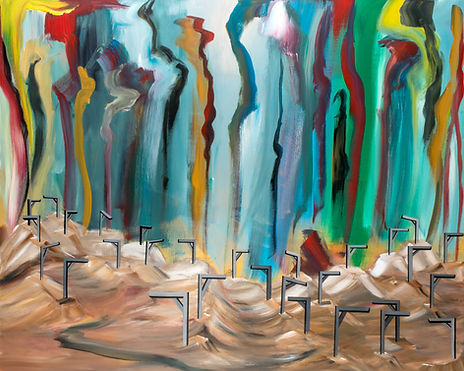
The artist: Cemo
The title: The Forest of Shame
Medium: acrylic&oil on canvas
Dimensions: 152 x 122 cm
The date: 05.03.2018. Middlesex University, London
Price:£10,000
The Forest of Shame is a work about colonialism, exploitation, political oppression and the physical destruction of human beings. It examines the contradiction between the processes of nature and the violence created by political and colonial systems.
Colonialism and exploitation can be understood through economic and historical structures that develop within human societies. Nature itself also contains systems of competition, adaptation and survival. In the natural world, we can observe processes such as natural selection and the struggle for survival.
But the deliberate physical extermination of human beings is something fundamentally different.
To destroy a people because of their identity, ethnicity or political existence is not an inevitable evolutionary process. It is a human choice. It is not progress, but a regression—a movement away from civilisation and towards barbarism.
Every living species has its own characteristics and its own long historical journey. Human communities, cultures and peoples likewise develop distinctive identities through centuries of experience, memory, language, culture and relationship with their land.
For me, the Kurdish experience is an important part of this question.
The existence of the Kurdish people and their aspirations for political and national rights have repeatedly been denied by states and political systems that have controlled Kurdish territories. Exploitation has often been accompanied by political repression, imprisonment, executions, displacement and the destruction of communities.
I see this prolonged violence as a historical process of physical and cultural destruction that unfolds over generations.
The Forest of Shame transforms this political and historical reality into a confrontation between two landscapes.
The background is colourful, energetic and alive.
The foreground is tragic, dry and barren.
I deliberately use two contrasting approaches to painting. One consists of free, raw and mixed colours, with long, expressive, almost uncontrolled brushstrokes. The other is precise, measured and deliberate, using straight lines, controlled forms and carefully considered colours.
These two visual languages exist together in the same painting.
The contrast is intentional.
There is life and death.
Happiness and sadness.
Good and evil.
Beauty and ugliness.
Nature and destruction.
Freedom and oppression.
The trees represent life. They are organic, growing and alive.
The gallows represent death. They are constructed, rigid and lifeless.
This distinction is important to me: nature creates and regenerates, while the instruments of political violence are manufactured by human beings.
The souls or figures within the painting appear volatile and indistinct, existing within a vibrant and energetic environment. In contrast, the gallows stand upon dry, infertile and apparently soulless ground.
The forest is alive.
The gallows are dead.
Yet both exist within the same frame.
This is the central contradiction of the painting.
The title The Forest of Shame refers not to nature itself, but to the shame of what human beings can do to one another. The forest becomes a witness to violence—a living environment surrounding the evidence of human destruction.
I wanted the painting to ask an uncomfortable question:
How can a civilisation that claims to progress continue to destroy human beings in the name of power, territory, identity and political interest?
For me, this is not simply a painting about the Kurdish people. Kurdish history provides the particular historical and emotional starting point, but the question extends beyond one people.
Whenever a human being is deliberately reduced to an enemy, a number, a category or something disposable, the same danger exists.
The Forest of Shame is therefore both a political statement and a reflection on humanity.
It is a confrontation between the natural process of life and the unnatural systems of destruction created by human beings.
The trees continue to grow.
The colours continue to live.
The souls continue to remember.
But the gallows remain as a monument to the shame of those who chose destruction over coexistence.

The artist: Cemo
The title: Redki Tribe
Medium: acrylic on canvas
Dimensions: 152 x 122 cm
The date: 2017, Middlesex University,London
Price:£10,000
Redki Tribe is inspired by my imagination and by the nomadic people of the Redki Tribe. These communities travel across mountains, plateaus, and deserts with their animals, living in tents from spring to autumn as they care for their herds and prepare yoghurt, butter, and cheese for the winter season.
In this painting, I experiment with colour and tone to create distinct sections of hills, valleys, and soil — landscapes that reflect the environment where I spent my childhood and teenage years. Through layered brushwork and shifting hues, the work becomes both a tribute to the tribe’s seasonal journey and a personal connection to the land that shaped my early life.

The artist: Cemo
The title: Immorality and Irrationality
Medium: oil on canvas
Dimensions: 152 x 122 cm
The date: 06.06.2020, Middlesex University, London
Price:£10,000,000
Immorality and Irrationality is an experimental work in which I deliberately attempted to move away from my previous methods and visual approaches to painting.
The work began with a central idea, but during its development many other ideas emerged. Rather than following a fixed plan, I allowed the painting to evolve through a continuous process of adapting, adding, removing, cancelling and altering. During the lockdown period, I experienced a sudden discovery that encouraged me to develop the work further and to explore a different direction within my practice.
At the centre of the painting is a subject that is extremely difficult to confront: the systematic violence inflicted upon Kurdish women in situations of war, imprisonment and political conflict.
The work refers to allegations and documented accounts of sexual violence, torture, execution, the mistreatment of prisoners, and the public humiliation and exposure of the bodies of Kurdish women who have been involved in political, military, activist and social movements.
Rather than reproducing these acts literally, I transform them into a symbolic and semi-surrealistic visual language.
My intention is first to confront what I understand as the immorality of political violence directed against Kurdish people. But the work goes beyond immorality. It also addresses the irrationality of power—the point at which political and military authority abandons reason, human dignity and fundamental principles of humanity.
The title therefore describes two interconnected failures.
Immorality refers to the deliberate violation of human dignity.
Irrationality refers to the abuse of power that allows such violence to become possible, justified or normalised.
The treatment of women is particularly significant in this work. The female body becomes a battlefield upon which political power attempts to demonstrate its control. Humiliation, sexual violence and the public exposure of women's bodies can become weapons intended not only to harm individuals, but also to intimidate entire communities.
By bringing these subjects into the painting, I want to expose violence that might otherwise remain hidden.
My work is also concerned with the relationship between past and present.
The violence represented here is not, in my understanding, an isolated contemporary phenomenon. It belongs to a longer historical pattern of political repression, massacre, genocide, imprisonment, violence, exile and displacement. History leaves traces, and those traces continue to appear in the present.
I therefore bring fragments of historical memory into contemporary painting.
The colours, forms and atmosphere of the work evoke a psychological landscape shaped by imprisonment, massacre, death, violence, exile and displacement. The painting becomes a space where past and present overlap.
This is one of the reasons I work through an experimental and semi-surrealistic language. I am not interested in simply illustrating a historical event. I want to reveal its psychological reality—the fear, humiliation, anger and trauma that remain after the event itself has ended.
The painting is therefore both an accusation and a testimony.
It asks what happens when power becomes detached from morality, and when violence is presented as a legitimate political instrument.
It also asks how far human beings can descend when they abandon reason, empathy and respect for human dignity.
For me, Immorality and Irrationality is ultimately a work about the abuse of power and the consequences of silence.
It is an attempt to bring hidden violence into visibility—not to glorify suffering, but to condemn it.
The painting remembers those who have been subjected to violence and challenges the systems that attempt to make such violence invisible.
**The body remembers.
History remembers.
Art remembers.**

The artist: Cemo
The title: The Viruses of Darkness
Medium: oil on canvas
Dimensions: 152 x 122 cm
The date: 2015, London Metropolitan University, London
Price:£2,000,000
Viruses of Darkness is a depiction of rape crimes by gangs against Kurdish children, after occupation of town of Sinjar in 2014. According to news, many children were captured and raped. They declared that all goods and women belonging to Kurd are halal for paramilitary gangs.
They deliberately kidnapped Ezdi Kurdish children to rape and impregnate and to change the original identity/DNA of their future generations. Even Ezdi children couldn't give birth because they were children when they got pregnant by gang members.

The artist: Cemo
The title: The Volunteers of Hell
Medium: oil on canvas
Dimensions: 152 x 122 cm
The date: 2015, London Metropolitan University, London
Price:£10,000,000
The Volunteers of Hell is based on a true story.
The siege of Kobane was launched by paramilitary gangs on 13 September 2014, in order to capture the Kobane Canton and its main city of Kobane in the de facto autonomous region of Rojava Kurdistan. 95% of Kobane was occupied by gangs.
In that battle 70% of Kobane city was destroyed. Then, a coalition was formed between Kurdish army YPG (Popular Protection Units), YPJ (Women's Defence Units), Peshmerga of southern Kurdistan region and the Global Coalition to defeat gangs, it was a historical resistance.
Between 15 September 2014 and 20 March 2015, YPG-led forces recaptured Kobane. That victory was the first defeat to the gangs in Kurdistan and in the Middle - East, and the resistance of US-backed forces, Kurdish troops YPG-YPJ continued until they recaptured Raqqa, capital city of gangs, on 17.10.2017.
Kurdish women's force YPJ had a heroic resistance and role in the battle of Rojava Kurdistan. All Kurds around the world came together and united, they had demonstrations and protests against invaders and for Rojava Kurdistan.
In this painting, I used semi-surrealist figures to depict the extraordinary, historical and heroic resistance of Kurdish women in the battle. Also, I intend to humiliate our enemies, the members of gangs, and describe them as animals.
The four women warriors are representing four parts of Kurdistan as the unity of the Kurd nation with the Kurdish flag and our national colours of red ,green, yellow and white on their legs and hairs.

The artist: Cemo
The title: 1,500,000 + 1
Medium: oil on canvas
Dimensions: 152 x 122 cm
The date: 2014, London Metropolitan University, London
Price:£2,000,000
As known, 1,500 000 Armenian were genocide by Ottoman Empire and Turkey during WW1, displaced from Turkey and Northern Kurdistan, and all their goods and properties were siezed. In fact, that genocide didn't stop against Armenian until now ,and at every opportunity Turkish state is still killing Armenian in Turkey. One of them was Armenian journalist Hrant Dink, who was a Turkish citizen. He wrote about Armenian genocide in his own newspaper, Agos. Because of this, the Turkish state ordered him to go to Istanbul governorship, and he was threatened by death if he did not stay silent. Finally, on 19 January 2007, Turkish authorities gave a gun to 17- years-old a fascist/nationalist boy, and Hrant Dink was assassinated in front of his office.
After being threatened, Hrant Dink says that he was as fearful, as the pigeons, and always looking over his shoulder for any attacker.
And, I covered his dead body with pigeons, instead of his newspaper Agos. Also, depicted pigeons moving on to Armenian way, which represents forced exile, displacement and genocide.

The artist: Cemo
The title: It Was Autumn When I Came
Medium: oil on canvas
Dimensions: 152 x 122 cm
The date: 2016, Middlesex University, London
Price:£10,000,000
This is an experimental contemporary work which is addressing Kurdish issue, history of Kurdistan, colonialism, fascism and resistance of Kurds.
On the top right side is the darkness of fascism,gangs, colonialism including symbols of oppression.
On the lower left side, my mother is pregnant with me. It was Autumn, when I was born, She was reading the history of Kurdistan. Autumn represents the situation of Kurdistan which means it is in the middle of its existence.
On the top left side, Kurdish women are playing, singing and dancing which symbolise fight and national resistance, and aiming for freedom, independence, peace, a colourful sky and life.
Our existence depends on the end of our resistance: It is possible that our enemies could erase us from history, and after Autumn our history can turn into Winter; or we can get victory and Kurd and Kurdistan can reach Spring and a new life.

The artist: Cemo
The title: Roboski Massacre
Medium: oil on canvas
Dimensions: 152 x 122 cm
The date: 2014, London Metropolitan University, London
Price:£1,000,000
Roboski Massacre is based on a true story and it is a documentary work about a deliberate massacre against Kurd and the mules belonging to Kurds.
It took place in Northern Kurdistan at 21:39 on December 28, 2011 near the Iraq-Turkey border when the Turkish Air Force bombed a group of civilians (including children), killing 34 and wounding 1.
The invading authorities made a decision regarding the border and placed a stone with number 15 on it to be recognised as their border. The massacre happened around that stone. In fact, both sides of that stone are Kurdistan and belonged to Kurds for many thousands of years. According to historians this area has been occupied and divided by colonisers since AD 637.
Despite paying customs duty to the Turkish army at the border to enter into Southern Kurdistan legally for business, these Kurds are considered as "terrorists" by Turkish authorities and killed by using chemical weapons. Despite all the complaints and protests by Kurds, Turkish authorities are still silent about this massacre!

The artist: Cemo
The title: Seven Days and Seven Nights
Medium: oil on canvas
Dimensions: 152 x 122 cm
The date: 2016, London
Price:£500,000
"57-years-old Taybet Inan was a mother of 11 children, from the town of Silopi, Northern Kurdistan.
The Turkish State declared a curfew in Silopi. On the 12th day of curfew which was 19 December 2015, Taybet Inan visited her neighbour and when she came back, she was killed in her courtyard. Her brother came running to help her but he was killed as well.
It was winter and her body was lying in the courtyard for seven days and seven nights, nobody had the permission to remove her body.
According to news, her children didn't sleep during that time and they kept watch and ward off stray dogs to keep their mother's body safe."

The artist: Cemo
The title: The Shepherd Who Created Art with his Bum
Medium: oil on canvas
Dimensions: 152 x 122 cm
The date: 2017, Middlesex university, London
Price:£100,000
This is an allegory which addresses invaders of Kurdistan, their president, politicians, authorities and people who admired them.
During the building of a one-man regime, Neo-Ottomanism and caliphate, the authorities of invaders implemented a two-sided plan against people and opposition: Oppression and Hunger.
Then,the authorities of invaders started to manipulate people and created a huge adulatory mass. And the lies became the only reality for the political oppressors. The majority of the masses bowed down to a one-man regime.
The leader of oppressors describes himself as a shepherd. And imitated Joseph Goebbels, propaganda minister of Nazi. The monarch, who put the masses to sleep, created art with his bum, and sang a lullaby to the masses, and they become slaves, creatures who are listening in awe, intoxicated, ecstatic and in trance.

The artist: Cemo
The title: 73rd Edict
Medium: oil on canvas
Dimensions: 152 x 122 cm
The date: 2017, Middlesex University, London
Price:£10,000,000
This work is based on a true story about Ezdi Kurds who didn't accept any other religion and remained as original Kurd with their own religion Yezdanizm, identity, language, history and culture until AD 637. This date was the attack of invaders with their foreign religion against Kurdistan and Kurd. According to Ezdi's claim, so far 73 genocide done against them by invaders.
On 3 August 2014, paramilitary gangs attacked the Kurdish town of Sinjar where Ezdi Kurds lived. It is a part of Southern Kurdistan. During the occupation of gangs, according to news, more than seven thousands Ezdi Kurd women, including Ezdi teenager girls and children, kidnapped, raped and have been sold as sex slave to rich invaders and others. Thousands of them were killed, and placed in a lot of mass graves. Many hundred thousands of them were forced exiled and displaced.
Ezdi women were sold as spoils of war at slave markets in Raqaa, the capital city of gangs.

The artist: Cemo
The title: Mules Massacre
Medium: acrylic&oil on canvas
Dimensions: 152 x 122cm
The date: 2017, Middlesex University, London
Price:£2,000,000
Mules Massacre is based on a true story. The massacre was carried out by colonialist Turkey and Iran in 2011 and in 2007.
One of the aforementioned massacres was carried out by the Turkish air force near Roboski village on the border between the northern part of Kurdistan (part of Turkey Kurdistan) and the southern part of Kurdistan (part of Iraq Kurdistan) on 28th of December 2011 between 9:37 and 22:24. There were 38 people who were marching with 50 mules. At the end of the air strike 34 people were killed, and one of them was injured. 17 of them were under 18-years-old, and 11 of them were relatives. The mules were carrying diesel, sugar, tobacco and food. Because of the bombs, humans and mules were broken into pieces, their bodies charred and mixed; as an horrific consequence, family members could not identify the bodies of their children.
The second massacre happened in the eastern part of Kurdistan (part of Iran Kurdistan), around Secoman village in April 2017. The mules were not carrying anything, but the Persian army fusillade them just because they belonged to the Kurd. Because of the regional war in the Middle East, there has been unrest, ferment, mayhem and changes in Kurdistan, in Kurdish society, and regarding the colonial status-quo as well.
I always wonder how I can find an artistic way or style to transfer the recent situation of Kurd and Kurdistan to re-create that unrest in my artworks. I have been thinking of such techniques as shaking, moving brushstrokes; rioting, rebelling colours; effusive figures; earthquake, war and fight.
Also, if possible, I would like to get a visual experience of beauty mingled with a disaster, a contrast in the same frame, so as to create a sense of spiritual harmony of complexity.
I have used a metaphor. I have tried to create empathy to feel the pain, the helplessness, the scream, and the cry. I have tried to perceive and to communicate the smell of gunpowder, its burning smell, the approaching footsteps of death, the blood that every second pours out from their veins.
And I have found it unbearable. Therefore, I have decided to close the eyes of mules with bandages to avoid seeing the terrible scene of the massacre which was perpetrated by so-called "humans", who are the most brutal and wild animals in the world!

The artist: Cemo
The title: Mr Shepherd and his Farm
Medium: oil on canvas
Dimensions: 152 x 122 cm
The date: 2017, Middlesex University, London
Price:£2,000,000
Generally, in the exploitative systems, in order to get elected and to get into power, to have authority over the masses, political parties sometimes use unethical tactics such as brainwashing and manipulating the population with religion and nationalism which can cause racism and discrimination. This then could cause millions to lose sight of reality and to be divided.
The minority of the population are victimised to the point where they are stripped of their legal rights. These political parties also use bribing techniques to put forth a strong campaign which further blinds the masses to vote for them. These are all done through the most powerful entity-the media. Millions are affected by this propaganda and are ready to attack one another because of their different ideologies.
I was inspired to create the piece entitled "Mr Shepherd and his Farm" after coming across a sentence spoken by a well-known candidate in Turkey who is a tyrant and is trying to be some kind of a monarch.
He said: " I am a shepherd. To manage the herd, you need to know the philosophy of the shepherd."
The dark background of the painting is symbolising the dark age of the regime which has been shaped in Turkey.
Thu bulbs and the naked bodies are symbolising the rape incidents and women in Turkey.
The animalistic figures are a reflection of the mob who were brainwashed, deceived; and have become a slave to the system.
The image of the penis shows that the people at the top who are in control only think about their own inhumane sexual pleasures and do not have the interest of the masses at heart.
The image of the salute gesture represents the synthesis of the fascist and nationalist party in Turkey, who hold the Turk-Islam ideology.
The snake symbolises unpredictable danger and potential attack by the enemies.
The dynamite head symbolises that at any time and anywhere, unexpectedly an explosion of trouble for people can occur like an explosion.
The green in the painting symbolises the farm that the dictator alludes to in his quote.
The sheep are the reflection of the people who blindly voted for him.
The dictator is on the shoulders and backs of the sheep; this shows that he is worshipped by the population, and they have fallen prey to all the lies and the propaganda put forth by his party to the point where he has become a leader who can do no wrong in the eyes of these brain-washed people.

The artist: Cemo
The title: Do It Yourself
Medium: acrylic on canvas
Dimensions: 152 x 122 cm
The date: 2018, Middlesex University, London
Price:£500,000
The painting titled "Do It Yourself" is a depiction of my situation at home. I have been unable to have a shower in the property I live in since 17th of October 2017 despite paying my full rent. My landlord destroyed the tiles and tarpaulin of my bathroom in order to fix it. After failing to fix it, I was told: " Do It Yourself".
In this painting, I am trying to show a gruesome image of a person that would appear after over four months who is not able to take a shower.
Since I was comically told "Do It Yourself", I wanted to respond back in the same comical manner, so my response to my landlord is this painting.
I left the bottom of the bathroom unfinished because I wanted this to represent my unfixed bathroom that still needs to be completed.
In addition, the distress of being unable to take a shower for a long time and the injustice of my landlord brought in me the feeling that I could live no more, in this endless struggle. To voice my despair, I started a hunger strike. For this reason, in the painting I portrayed myself holding a gun at my head with the bathtub in front symbolising my grave.

The artist: Cemo
The title: Protest
Medium: oil on canvas
Dimensions: 152 x 122 cm
The date: 2017, Middlesex University, London
Price:£5,000,000
According to news, between 1984-1999 about four thousand Kurd's villages were destroyed and burned by Turkish authorities during the conflict between Kurdish guerrillas and Turkish army. Later on, the Turkish state started to destroy Kurdish towns and cities as well. In addition, they burned Kurd and their cattle as well. Because of those attacks and reoccupation of Kurdistan, millions of Kurds were displaced, exiled and dispersed.
According to human right organisations, 18,000 Kurds were murdered and they are described as "unknown murders".
I intend to depict that atmosphere in Kurdistan, a scene of burned bodies of Kurds and their Cattles by rising smoke, savagery, violence and oppression against Kurds. I also imagined a protest by Kurds against savagery of Turkish authorities as resistance.

The artist: Cemo
The title: Thirteen Bullets
Medium: oil on canvas
Dimensions: 100 x 70 cm
The date: 2005, Istanbul
This work is based on a true story. Ugur Kaymaz was a 12-years-old Kurdish boy who lived in the town of Kiziltepe/Kurdistan. The Turkish state killed him on 21 November 2004 with 13 bullets in front of their house alongside his father and declared them as terrorists.
The Turkish state counted each of the 12th bullets for Ugur Kaymaz's age, and counted the 13th one for the time Ugur Kaymaz spent in his mother's womb.
I tried to use a different technique for this painting than the previous ones. I built Ugur Kaymaz's body with 13th bullets, and covered the land of their courtyard full of bullets as current situations in the land of Kurdistan.
I put two tin cans full of skulls instead of bottled food found in mass graves which were used byTurkish army.
On the left side of the painting, I set a gallows which is a face as well. On the right side of the painting, I painted the letter L as a soldier's boot and gallows with a hanged Kurd. in the middle of the painting, I put Ugur Kaymaz's mother. Her body is in pieces and in rebellion, same as Kurdistan.
I used some symbols to represent colonial law, judge gavel, war plane, skull, a bloody book of Kurdistan history and no peace in Kurdistan.

The artist: Cemo
The title: Return of Apollyones
Medium: oil on canvas
Dimensions: 152 x 122 cm
The date: 2014, London Metropolitan University, London
Price:£100,000
From the beginning of the Syrian civil war in 2011, the colonialist Turkish state collected all Apollyon’s guards of Hell, and brought them to the World. IS declared all people around the world as infidels, except Sunni Muslims. They targeted the infidels and turned the world into hell. IS said that they have the right to destroy infidels and send them to hell according to their religious teachings and beliefs. Also, if any IS member loses their life, they will be honoured and definitely will go to heaven as a martyr.


The artist: Cemo
The title: Advanced Democracy
Medium: oil on canvas
Dimensions: 70 x 70 cm
The date: 2016, London
Haci Lokman Birlik was a 24-year-old Kurdish actor. Turkish police shot 25 bullets at close range and took his life at the scene on 3 October 2015.
The savage torture perpetrated on Birlik's body was first exposed by a photo circulated on social media. Several days later, police vehicle dragged Birlik's body in the streets of Kurdish city Sirnak, and circulated the picture in October 2015.
The artist: Cemo
The title: Kendakol Massacre
Medium: acrylic on canvas
Dimensions: 100 x 100 cm
The date: 2013, London Metropolitan University, London
Colonialist Turkish state had an air attack on 15 August 2001 at the Kendakol area in Southern Kurdistan and killed 44 civilians. Turkish state has chosen Tamil genocide which was created by colonialist Srilanka state as a role model. From 1982 until present, systematic attacks of the Turkish state have continued. The Turkish state is deliberately targeting Kurdish civilians, Kurdish villages, farms and forests to exile, to remove Kurds and to invade and to control Southern Kurdistan.
The Turkish state has a plan to seize oil of Kerkuk and Musul by force, and also rebuild the Ottoman Empire. Then, expand the borders of Turkey to as its status-quo of WW1.

The artist: Cemo
The title: Obvious and Hidden
Medium: oil on canvas
Dimensions: 100 x 100 cm
The date: 2014, London Metropolitan University,London

The artist: Cemo
The title: Revolution
Medium: oil on canvas
Dimensions: 100 x 100 cm
The date: 2014, London

The artist: Cemo
The title: Armenian Genocide
Medium: acrylic on canvas
Dimensions: 100 x 100 cm
The date: 2014, London Metropolitan University, London

The artist: Cemo
The title: Sunrise
Medium: oil on canvas
Dimensions: 100 x 100 cm
The date: 2014, London

The artist: Cemo
The title: Collaboration
Medium: oil on canvas
Dimensions: 100 x 100 cm
The date: 2014, London Metropolitan University, London

The artist: Cemo
The title: Aunt Ire
Medium: oil on canvas
Dimensions: 100 x 100 cm
The date: 2014, London

The artist: Cemo
The title: Fertilization
Medium: oil on canvas
Dimensions: 100 x 100 cm
The date: 2015, London Metropolitan University,London

The artist: Cemo
The title: Foreground and Background
Medium: acrylic on canvas
Dimensions: 100 x 100 cm
The date: 2014, London Metropolitan University, London

The artist: Cemo
The title: Red Genocide
Medium: oil on canvas
Dimensions: 100 x 100 cm
The date: 2008, London

The artist: Cemo
The title: Red Genocide
Medium: oil on canvas
Dimensions: 100 x 100 cm
The date: 2014, London

The artist: Cemo
The title: Tent
Medium: acrylic on canvas
Dimensions: 100 x 100 cm
The date: 2013, City&Islington College, London

The artist: Cemo
The title: From Zagros to Agiri
Medium: oil on canvas
Dimensions: 100 x 100 cm
The date: 2017, Middlesex University, London

The artist: Cemo
The title: Alan Kurdi
Medium: oil on canvas
Dimensions: 100 x 100 cm
The date: 2016, Middlesex University, London

The artist: Cemo
The title: Garden
Medium: acrylic on canvas
Dimensions:100 x 100 cm
The date: 2014, London Metropolitan University, London

The artist: Cemo
The title: Rainbow
Medium: oil on canvas
Dimensions: 100 x 100 cm
The date: 2014, London Metropolitan University, London

The artist: Cemo
The title: Polar Bears
Medium: acrylic on canvas
Dimensions: 100 x 100 cm
The date: 2014, London Metropolitan University, London

The artist: Cemo
The title: Global Terrorism and Territorial Redesing
Medium: acrylic on canvas
The date: 2015, London Metropolitan University, London

The artist: Cemo
The title: See-Saw
Medium: acrylic on canvas
Dimensions: 100 x 100 cm
The date: 2016, London

The artist: Cemo
The title: Wakening
Medium: acrylic on canvas
Dimesions: 100 x 100 cm
The date: 2014, London Metropolitan University, London

The artist: Cemo
The title: Plateau
Medium: oil on canvas
Dimensions: 40 x 30 cm
The date: 2017, Middlesex University. London

The artist: Cemo
The title: Sunset
Medium: oil on canvas
Dimensions: 30 x 20 cm
The date: 2016, Middlesex University. London

The artist: Cemo
The title: Anonymous (1)
Medium: oil on canvas
Dimensions: 70 x 50 cm
The date: 2014, City&Islington College, London

The artist: Cemo
The title: Anonymous (2)
Medium: oil on canvas
Dimensions: 70 x 50 cm
The date: 2014, City&Islington College, London

The artist: Cemo
The title: Hunger Strike (1)
Medium: oil on canvas
Dimensions: 70 x 50 cm
The date: 2014, City&Islington College, London

The artist: Cemo
The title: Bird Flue
Medium: oil on canvas
Dimensions: 70 x 50 cm
The date: 2007, London

The artist: Cemo
The title: Hunger Strike (2)
Medium: acrylic on paper
Dimensions: 30 x 20 cm
The date: 2014, City&Islington College, London

The artist: Cemo
The title: Hugs the Star that who Falls into Space
Medium: oil on canvas
Dimensions: 100 x 70 cm
The date: 2005, Istanbul

The artist: Cemo
The title: Bahtiyar
Medium: oil on canvas
Dimensions: 100 x 70 cm
The date: 2005, Istanbul

The artist: Cemo
The title: Buttermilkmaker Women
Medium: oil on canvas
Dimensions: 70 x 50 cm
The date: 2004, Istanbul

The artist: Cemo
The title: Grandmother Seyran
Medium: oil on canvas
Dimensions: 70 x 50 cm
The date: 2004, Istanbul

The artist: Cemo
The title: Uncle Musa
Medium: oil on canvas
Dimensions: 100 x 70 cm
The date: 2005, Istanbul

The artist: Cemo
The title: Love
Medium: oil on canvas
Dimensions: 70 x 50 cm
The date: 2001, Istanbul

The artist: Cemo
The title: Lost Generation
Medium: oil on canvas
Dimensions: 70 x50 cm
The date: 2004, Istanbul

The artist: Cemo
The title: Interrogation
Medium: oil on canvas
Dimensions: 73 x 54 cm
The date: 2002, Istanbul

The artist: Cemo
The title: Dream
Medium: oil on canvas
Dimensions: 70 x 50 cm
The date: 2004, Istanbul

The artist: Cemo
The title: Kurd
Medium: oil on canvas
Dimensions: 70 x 50 cm
The date: 2004, Istanbul

The artist: Cemo
The title: Unsuspicious Murder
Medium: oil on canvas
Dimensions: 60 x 50 cm
The date: 2004, Istanbul

The artist: Cemo
The title: Death Operation
Medium: oil on canvas
Dimensions: 70 x 50 cm
The date: 2004, Istanbul

The artist: Cemo
The title: Observation
Medium: oil on canvas
Dimensions: 70 x 50 cm
The date: 2005, Istanbul

The artist: Cemo
The title: Rebellion
Medium: oil on canvas
Dimensions: 70 x 50 cm
The date: 2004, Istanbul


The artist: Cemo
The title: Match
Medium: oil on canvas
Dimensions: 70 x 50 cm
The date: 2004, Istanbul

The artist: Cemo
The title: Stories of Deers
Medium: oil on canvas
Dimensions: 70 x 50 cm
The date: 2005, Istanbul


The artist: Cemo
The title: Rain and Rose Gardener
Medium: oil on canvas
Dimensions: 70 x 50 cm
The date: 2006, Fethiye/Turkey

The artist: Cemo
The title: Global Warming
Medium: oil on canvas
Dimensions: 100 x 70 cm
The date: 2005, Istanbul

The artist: Cemo
The Title: Exile
Medium: oil on canvas
Dimensions: 70 x 50 cm
The date: 2002, Istanbul

The artist: Cemo
The title: Warning
Medium: oil on canvas
Dimensions: 70 x 50 cm
The date: 2004, Istanbul

The artist: Cemo
The title: Stream Esen
Medium: oil on canvas
Dimensions: 50 x 30 cm
The date: 2006, Kemer-Fethiye/Turkey

The artist: Cemo
The title: Lake Zagros
Medium: oil on canvas
Dimensions: 70 x 50 cm
The date: 2004, Istanbul

The artist: Cemo
The title: Family
Medium: oil on canvas
Dimensions: 30 x 20 cm
The date: 1997, Istanbul

The artist: Cemo
The title: Harvest Time
Medium: oil on canvas
Dimensions: 70 x 50 cm
The date: 2004, Istanbul

The artist: Cemo
The title: Mutants
Medium: oil on canvas
Dimensions: 152 x 122 cm
The date: December 29, 2020. London
Price:£500,000
This work is one of series paintings on Covid-19 disaster. It is a scene of battle between viruses and health workers as two armies.
On the left side, the mutants army is leading by their commander, and in an attack position. This army is globally always changing its form, and becoming invisible, more harmful, and more lethal against human.
On the right side, the health workers are circle people to protect them against attack of mutants.
It depicts a war and genocide from mutants against human.

The artist: Cemo
The title: Milking
Medium: oil on canvas
Dimensions: 70 x 50 cm
The date: 2004, Istanbul

The artist: Cemo
The title: Sacrifice
Medium: oil on canvas
Dimensions: 70 x 50 cm
The date: 2004, Istanbul

The artist: Cemo
The title: It comes back in some forms
Medium: acrylic on canvas
Dimensions: 152 x 122 cm
The date: 08.03.2021. London
Price:£5,000,000
This work also inspired by pandemic and created in situations of Covid-19 lockdown.
It depicts mental and pyschological choas of a person who has been in prison, tortured and exiled by force from his motherland and lives in diaspora. Who, again and again, day and night saw nightmares and dreams about his background.
As an artist, during the pandemic and lockdown, I called it " self arrest"and tried to create a link between conditions of detention, torture and overwhelming conditions of Covid-19 and lockdown.

The artist: Cemo
The title: It comes back in some forms
Medium: acrylic on canvas
Dimensions: 152 x 122 cm
The date: 08.03.2021. London

The artist: Cemo
The title: We were about thirty eight people
Medium: oil on canvas
Dimensions: 152 x 122 cm
The date: 15.05.2021. London
Price:£100,000
This work is based on a true story. It depicts a military operation by Turkish state against Kurds on Agiri Mountain in Winter time at Northern Kurdistan.
Because of land and air attack and siege operations, Kurdish fighters are changing their position, and moving to Eastern Kurdistan. They are on a walk around River Aras, and passing the fake and illegal borders of Kurdistan to save themselves against the operation.

The artist: Cemo
The title: Before it's all over
Medium: acrylic on canvas
Dimensions: 152 x 122 cm
The date: 15.07.2021. London
Price:£5,000,000
This work is portraying our silence, our callousness and our indifference against war, against environmental disaster and against economic crisis.
And because of our this fatalistic attitude, I give a rebellion role to deads and ghost as a reaction to save our life and our world to live together in peace.

The artist: Cemo
The title: Elimination
Medium: acrylic on canvas
Dimensions: 152 x 122 cm
The date: November 2016 - November 2024. London
Price:£10,000,000
Elimination is an experimental political work addressing unrest and unresolved violence occurring in many parts of the world, particularly in Kurdistan. The painting reflects themes of assassination, unsolved murders, and the public’s reaction and resistance to these ongoing injustices.
To express these ideas, I use a unique metaphor: scattered letters represent people and the wider public in a state of anger and movement. The assassinated P symbolises an individual victim, while the number 4 represents the murderer. This coded visual language transforms letters into human presence and conflict.
The background is built with my distinctive brushstroke technique, creating a sky filled with movement, turbulence, and chaos. These shifting textures echo the instability of the political landscape and the emotional intensity of communities living through these events.